
Royalty Medical Billing Firm
The Royalty Standard™ in Revenue Governance
Calling all IPAs, MSOs, Medicare Advantage organizations, and delegated medical groups — 2027 is approaching fast. Are you ready?
In a capitated and risk-based environment, revenue is only as strong as the documentation, member risk, encounter data, contractual responsibilities, and clinical activity supporting it.
Royalty Medical Billing Firm helps connect the dots between the contract, the provider, the medical record, the encounter, the risk profile, and the revenue — helping your organization identify gaps, strengthen oversight, and stay audit-ready before the numbers are already final..
Stay Ready So You Don’t Have To Get Ready™!
WHERE ARE THE GAPS IN YOUR REVENUE SYSTEM?
Let us ask the questions. Then let us help you close the gaps.
LET US ASK:
HOW WE CAN HELP:
PROVIDER DOCUMENTATION & MEAT
Is your provider documentation consistently meeting MEAT standards and supporting the conditions being reported?
Incomplete documentation, unsupported diagnoses, and missed chronic-condition assessment can affect risk accuracy, reimbursement, and audit defensibility
Are chronic conditions being actively assessed and documented?
Are reported diagnoses supported by the medical record?
Are documentation gaps affecting RAF/HCC accuracy?
Could unsupported or incomplete documentation create reimbursement or audit risk?
Strong documentation supports accurate risk reporting, appropriate reimbursement, and audit defensibility.
PROVIDER DOCUMENTATION & RISK INTEGRITY REVIEW
We look to identify gaps, strengthen clinical and coding alignment, and provide practical guidance your team can use to improve documentation quality and revenue integrity.
Our review looks beyond the code itself to evaluate whether the documentation, diagnosis support, and risk-adjustment elements are working together consistently.
We help your organization:
Review documentation for MEAT support and clinical specificity
Identify coding integrity and chronic-condition capture gaps
Flag documentation that may affect risk accuracy and reimbursement
Provide actionable reporting your team can use
Support provider education and documentation improvement
Strengthen documentation at the point of care
Better documentation creates a stronger foundation for accurate risk reporting, compliant coding, and defensible revenue.
DOFR & FINANCIAL RESPONSIBILITY
Our review examines whether contractual responsibilities, authorization requirements, payer obligations, and payment activity are aligned and where breakdowns may be creating avoidable revenue loss.
When financial responsibility is unclear, reimbursement problems can quickly become operational and revenue problems.
Are services being denied because responsibility is unclear?
Are claims or encounters being sent to the wrong responsible entity?
Are services being written off when another party may be financially responsible?
Are authorization requirements aligned with the DOFR and delegated agreement?
Are providers or medical groups absorbing costs they should not be carrying?
Are unresolved responsibility disputes creating avoidable revenue leakage?
If your team cannot clearly identify who owns the service, the authorization, and the payment responsibility, revenue may already be falling through the gaps.
DOFR & FINANCIAL RESPONSIBILITY REVIEW
Our review examines whether contractual responsibilities, authorization requirements, payer obligations, and payment activity are aligned and where breakdowns may be creating avoidable revenue loss.
Clear financial responsibility is essential in delegated and capitated environments.
We help your organization:
Review DOFR provisions and delegated responsibilities
Identify gaps in financial responsibility and payer accountability
Assess authorization requirements and operational alignment
Analyze payment patterns for misdirected, denied, or unreconciled services
Identify areas of potential revenue leakage or inappropriate financial exposure
Support appropriate escalation, dispute, and appeal strategies when warranted
When financial responsibility is clearly defined and consistently applied, your organization is better positioned to reduce avoidable write-offs, resolve payment disputes, and protect revenue.
RAF / HCC & CHRONIC CONDITION CAPTURE
Are chronic conditions being identified, evaluated, documented, and reported appropriately each year?
A condition listed in the chart does not automatically mean it has been clinically addressed or accurately reflected in the member’s current risk profile.
Are chronic conditions being reassessed and documented annually?
Are diagnoses supported by the current clinical picture and medical record?
Are providers consistently documenting the elements needed to support MEAT and risk adjustment?
Are conditions being missed because they remain only on the historical problem list?
Are coding and documentation gaps affecting RAF/HCC accuracy?
Are encounter and diagnosis reporting processes capturing the conditions that were actually addressed?
If the condition is not appropriately evaluated, documented, coded, and reported, the member’s risk profile may not accurately reflect the care being managed.
RAF/HCC & CHRONIC CONDITION INTEGRITY REVIEW
We look at how clinical documentation, coding, risk adjustment, and encounter reporting work together to support an accurate and defensible member risk profile.
A diagnosis on a problem list does not tell the whole story. The condition must be actively evaluated, clearly documented, accurately coded, and properly reported so the patient’s true clinical complexity is reflected and the revenue tied to managing that risk is appropriately supported.
We help your organization:
Review documentation for HCC/RAF opportunities and clinical support
Evaluate MEAT support and annual chronic-condition reassessment
Identify missed, incomplete, or unsupported condition capture
Review coding for accuracy, specificity, and risk-adjustment alignment
Assess whether qualifying diagnoses are flowing through encounter reporting
Provide provider-level education and actionable reporting
Identify trends that may require workflow or documentation improvement
Accurate risk begins with an accurate clinical story — identified, supported, reported, and consistently reassessed.
ENCOUNTER INTEGRITY
Do you know whether every qualifying encounter is making it through the entire reporting process?
A visit can happen, be documented, and be coded correctly but if the encounter does not move through the reporting process successfully, the clinical and financial value of that service may never be fully reflected downstream..
Are encounters being submitted completely and on time?
Are rejected or incomplete encounters being identified and corrected?
Are diagnosis codes flowing through the encounter data as intended?
Are delayed encounters creating gaps in risk reporting or reconciliation?
Are rejected encounters being tracked to resolution?
Is there a clear process for reconciling what was performed, documented, coded, and ultimately accepted?
If the encounter is not successfully reported and reconciled, the work may have happened but the data may never tell the full story.
ENCOUNTER INTEGRITY REVIEW
We examine how encounters move from the point of service through submission, acceptance, reconciliation, and follow-up.
A documented visit only creates value if the encounter makes it all the way through the system. Rejected, delayed, or unreconciled data can leave the clinical story incomplete and the revenue story incomplete with it.
We help your organization:
Review encounter capture and submission workflows
Identify rejection and denial patterns
Assess whether diagnoses are being transmitted accurately
Evaluate delays that may affect risk reporting and reconciliation
Track rejected or incomplete encounters through resolution
Review reconciliation and escalation processes
Identify where encounter data may be contributing to revenue leakage or reporting gaps
Ensure the care that was delivered, documented, and coded is also accurately reflected in the data that supports risk, payment, and revenue.
CAPITATION RECONCILIATION
Are your capitation payments aligned with the members, contracts, risk, and responsibilities your organization is managing?
Receiving a capitation payment does not automatically mean the payment is complete, accurate, or aligned with the work and risk your organization is carrying.
Are all attributed or assigned members reflected correctly in payment reports?
Do payment amounts align with the terms of the capitation agreement?
Are changes in membership, eligibility, or risk being reflected timely?
Are payment variances being identified and investigated?
Are delegated responsibilities being matched to the payments your organization receives?
Are capitation reports being reconciled against contracts, member data, and operational activity?
Are unresolved discrepancies creating missed revenue or avoidable financial exposure?
If capitation is being received but not routinely reconciled, your organization may not know whether the payment actually matches the population, risk, and responsibility it is managing.
CAPITATION RECONCILIATION REVIEW
We take a closer look at the relationship between your membership, contract terms, payment methodology, and actual capitation activity to identify where discrepancies or unresolved variances may be affecting financial performance.
Receiving a capitation payment is only the beginning. The real question is whether that payment accurately reflects the members, risk, and responsibilities your organization is managing.
We help your organization:
Review membership and attribution data
Evaluate capitation payment methodology
Compare payment activity against contractual terms
Identify payment variances and reconciliation gaps
Assess whether changes in eligibility, membership, or risk are being reflected appropriately
Review capitation reports for missing, inconsistent, or unexpected payment activity
Strengthen reconciliation and financial oversight processes
Support follow-up on discrepancies that may require payer clarification or escalation
Consistent capitation reconciliation gives your organization greater visibility into whether the dollars received truly match the population, contract, and financial responsibility being managed.
CONTRACT & PAYER ALIGNMENT
Do your operational workflows actually match what your payer contracts require?
A contract can look clear on paper while the day-to-day operation tells a very different story. When workflows, authorizations, reporting requirements, delegated responsibilities, and payment terms are not aligned, revenue and compliance gaps can develop quietly.
Are your teams following the authorization and referral requirements outlined in the contract?
Do operational workflows match the organization’s delegated responsibilities?
Are payment methodologies being applied the way the contract specifies?
Are reporting and encounter requirements being completed accurately and on time?
Are contract terms being interpreted consistently across departments and providers?
Are payer updates or amendments being incorporated into current workflows?
Are misaligned processes contributing to denials, payment variances, or financial exposure?
A contract only protects revenue when the operation behind it is actually aligned with what the agreement requires.
CONTRACT & PAYER ALIGNMENT REVIEW
We connect the contract to the day-to-day operation to determine whether payer requirements, reimbursement terms, delegated responsibilities, and internal workflows are actually working together as intended.
The contract may define the rules, but the workflow determines whether those rules are followed and whether the revenue tied to them is protected.
We help your organization:
Review payer contract requirements and reimbursement provisions
Evaluate delegated responsibilities and operational ownership
Compare contract terms against current workflows and processes
Assess authorization, referral, and reporting requirements
Identify gaps between expected and actual payment activity
Review payer amendments or updates for operational impact
Identify areas of potential revenue leakage, denials, or financial exposure
Provide actionable findings to support workflow correction and payer alignment
When the contract, workflow, and payment activity are aligned, your organization is better positioned to reduce avoidable errors, strengthen accountability, and protect revenue.
AUDIT & COMPLIANCE READINESS
If your records, encounters, diagnoses, and payments were reviewed tomorrow would the story hold together?
Audit readiness should be built into the operation before a request ever arrives. When documentation, coding, encounter data, payer requirements, and payment activity do not align, small inconsistencies can become larger compliance and financial concerns.
Are diagnoses supported by the medical record and current clinical documentation?
Do encounter submissions match what was documented and coded?
Can your team clearly trace the relationship between care delivered, risk reported, and payment received?
Are payer and contractual requirements being followed consistently?
Are documentation or reporting gaps being identified before an audit does?
Is there a clear process for correcting, escalating, and tracking compliance issues?
Would your organization be able to produce a consistent, defensible audit trail if asked today?List item 1
Audit readiness is not a last-minute exercise it is the result of documentation, reporting, and revenue processes that stay aligned every day.
AUDIT & COMPLIANCE READINESS REVIEW
We examine whether the documentation, coding, clinical support, encounter data, payer requirements, and revenue reporting all tell the same story — and where inconsistencies may create compliance or financial exposure.
Audit readiness is strongest when the record, the code, the encounter, and the payment all support one another before anyone asks to see them.
We help your organization:
Review documentation and coding alignment
Evaluate whether diagnoses have appropriate clinical support
Compare encounter activity against reported conditions and services
Assess compliance with payer and contractual requirements
Identify gaps in revenue and risk reporting
Flag inconsistencies that may require correction or escalation
Support stronger audit trails and documentation practices
Provide actionable findings so issues can be addressed before they become larger problems
A strong compliance posture is built through consistent oversight — not last-minute preparation.
Specialized Support. Full-Cycle Oversight. One Revenue Governance Partner.
ONE REVENUE GOVERNANCE PARTNER.
Whether you need help with a defined revenue concern, a specialized project, or ongoing oversight of your complete revenue cycle, Royalty Medical Billing Firm meets your organization where it is—and helps build the structure it needs next.
FOCUSED REVIEWS & SPECIAL PROJECTS
Targeted expertise for a specific financial, operational, documentation, or compliance concern.
“A focused review should do more than identify a problem it should reveal what failed, what it affected, and what must change.”
Revenue Governance Reviews
Coding and documentation audits
MEAT and medical-necessity reviews
Denial and underpayment investigations
Aged A/R recovery projects
Contract-to-payment variance reviews
EHR and revenue-workflow assessments
Audit-readiness and corrective-action support
Best for organizations that need a defined issue examined, corrected, and strengthened.
GOVERNED REVENUE CYCLE MANAGEMENT
Disciplined day-to-day revenue operations supported by continuous monitoring and accountability.
“Submitting claims is an activity. Governing the entire process behind those claims is a revenue strategy.”
Eligibility and benefit validation
Authorization-to-revenue oversight
Coding and claim-readiness review
Clean-claim submission and tracking
Rejection and denial management
Payment posting and reconciliation
A/R follow-up and escalation
Performance reporting and trend analysis
We do more than process claims. We govern the documentation, workflows, decisions, and financial activity behind them.
STRATEGIC REVENUE GOVERNANCE
Ongoing oversight across traditional reimbursement, managed care, and emerging payment structures.
Full-cycle revenue oversight
Fee-for-service and managed-care alignment
Capitation and encounter monitoring
RAF/HCC and documentation integrity
Payer, IPA, MSO, and DOFR alignment
Payment-integrity and revenue-leakage monitoring
Compliance and audit preparedness
Executive reporting and governance reviews
Best for organizations seeking stronger accountability, greater revenue stability, and a scalable foundation for growth.
A SPECIAL PROJECT OR THE FULL REVENUE CYCLE—RMBF IS BUILT TO GOVERN IT.
With 20 years of allied-health and revenue-cycle experience, we bring boots-on-the-ground insight to the systems affecting documentation, coding, reimbursement, compliance, and financial performance.
We help you identify the gaps, strengthen the process, protect supported revenue, and position your organization for sustainable growth.
FIND THE GAPS. STRENGTHEN THE SYSTEM. PROTECT THE REVENUE.
THE DATA BEHIND THE RISK
THE GAPS AREN’T JUST OPERATIONAL. THEY CAN BECOME FINANCIAL.
Documentation, risk capture, encounter reporting, contracts, and reconciliation ultimately connect to payment. National Medicare Advantage data shows that inaccuracies can result in revenue moving in both directions underpayment and overpayment exposure.
WHAT COULD THIS MEAN FOR YOUR ORGANIZATION?
Even modest error-rate scenarios applied to annual capitated revenue can translate into meaningful dollars at stake.
Annual Capitated Revenue × documented CMS error-rate scenario = potential dollars affected.
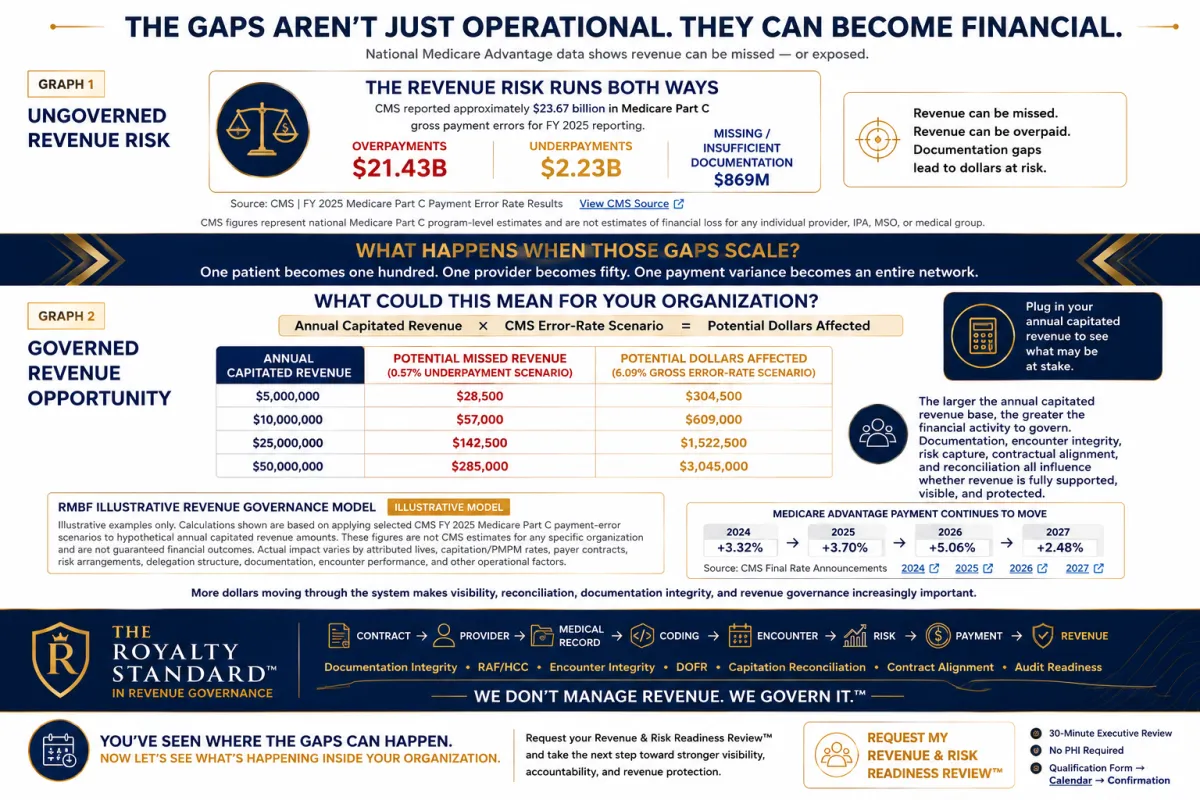
The larger the annual capitated revenue base, the greater the financial activity to govern. Documentation, encounter integrity, risk capture, contractual alignment, and reconciliation all influence whether revenue is fully supported, visible, and protected.
UNGOVERNED REVENUE RISK
CMS reported $23.67B in Medicare Part C gross payment errors for FY 2025 reporting, including $21.43B in overpayments and $2.23B in underpayments. The findings reinforce how unsupported diagnoses, incomplete documentation, and missed condition capture can affect payment integrity. This RMBF illustrative model applies CMS's reported 0.57% Part C underpayment rate and 6.09% gross improper-payment rate to hypothetical annual capitated revenue amounts to demonstrate how relatively small percentages can translate into meaningful dollars as a revenue base grows.
Based on: CMS FY 2025 Medicare Part C Payment Error Rate Results.
GOVERNED REVENUE OPPORTUNITY
This RMBF illustrative model applies CMS's reported 0.57% Part C underpayment rate and 6.09% gross improper-payment rate to hypothetical annual capitated revenue amounts to demonstrate how relatively small percentages can translate into meaningful dollars as a revenue base grows.
Based on: RMBF calculations using selected CMS FY 2025 Medicare Part C payment-error rates. Illustrative only; not a projection or guarantee of financial results.
CMS figures are national Medicare Part C program-level estimates. RMBF illustrative calculations are for educational purposes only; actual organizational impact varies by contracts, attributed lives, risk arrangements, documentation, encounters, and payment methodology.
THIS IS WHERE THE ROYALTY STANDARD™ CONNECTS THE DOTS.
CONTRACT → PROVIDER → MEDICAL RECORD → CODING → ENCOUNTER → RISK → PAYMENT → REVENUE
Your revenue does not operate in isolated departments and neither should your oversight.
The Royalty Standard™ examines the system behind the payment, helping organizations identify gaps earlier, strengthen accountability, and improve visibility across the revenue cycle.
We Don’t Manage Revenue. We Govern It.
STAY READY SO YOU DON’T HAVE TO GET READY!
Before the audit.
Before the payment discrepancy.
Before the rejected encounter.
Before the documentation gap becomes financial exposure.
Stay ready. Stay aligned. Stay governed.
YOU’VE SEEN WHERE THE GAPS CAN HAPPEN.
NOW LET’S SEE WHAT’S HAPPENING INSIDE YOUR ORGANIZATION.
Royalty Medical Billing Firm's Revenue & Risk Readiness Review™ provides an executive-level look at the systems connecting your contracts, providers, documentation, encounters, risk, financial responsibility, and revenue.
FIND THE GAPS. STRENGTHEN THE SYSTEM. PROTECT THE REVENUE.
STAY IN CONTACT
30-Minute Executive Review • No PHI Required
Facebook
Instagram
LinkedIn
Youtube
TikTok